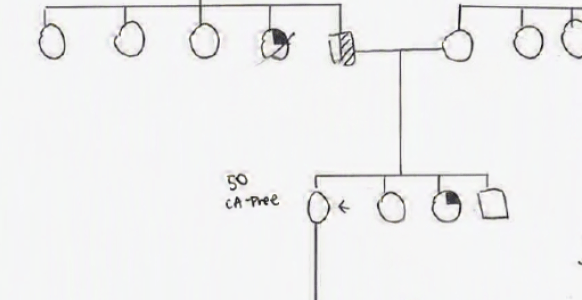
87% possibility of breast cancer. Or is it probability? With numbers, probability is the more accurate word. 65% of ovarian cancer, and less than 5% of pancreatic cancer. Accompanied by geometrical drawings on a piece of paper (females are circles, males are squares, and cancer is a little black segment), a box of tissues, and my entire family history. The doctors made great efforts to pronounce and spell the Irish names and asked was there any chance my parents were related? (I wasn’t sure if this was a question posed to every patient.) Was I a patient?
At the time of this first appointment I am, to put it in numbers, 100% healthy. (In body, at least)
A list of recommendations:
- Bilateral salpingo-oopherectomy (ovarian cancer is more difficult to discern, tucked away amongst the other organs in the abdominal tissue).
- Alternating mammograms with MRI scans every six months (monitoring the 87% inevitable?) or directly opting for a double mastectomy.
- Being thankful that my family is not one of those that has high rates of pancreatic cancer. (I can not imagine this.)
That was the list and the numbers and the statistics, all clearly explained in soft voices. I had heard the information before (exactly 2 times before, with each of my sisters). One sister was lucky. One sister was not lucky. My unlucky sister had 1 mammogram, 2 ultrasounds, 1 biopsy, and then a diagnosis of triple negative breast cancer. (Even the names of the cancers have numbers in them.) Then came a very long year of watching my (little) sister have 16 chemotherapy sessions, one 10-hour surgery, 2 urgent trips to the emergency department and 27 weeks of immunotherapy. Although at this point, I should also include the 1,000 acts of kindness she received from all over the world. Cancer is a horrible disease but it shines a light on all the love around it too.
Today, I struggle to grasp this phantom illness, this choice to remove healthy parts of my body before they become unhealthy. This dual-version story of probabilities, full of informative numbers that are useless at providing any meaning. I try to explain to others what I cannot fathom myself, giving them the numbers, repeating the information, telling them what it is. But they brush aside the figures and percentages, fully aware that the significance is in other places. ‘But, how are you?’ they ask.
This used to be an easier question. I remember how the days of chronic pain were all mine: I would see the movement of my future self stretch out before me, a sketchy outline of multiple figures climbing stairs or bending over or crouching down, the heat oozing from the aching spots. The pain was a tangible reference for frustration and the source of much motivation.
Whereas now, the meaning is abstract, until I watch the nurses struggle to find a vein in my sister’s arm. Until the oncologist, discussing the mastectomy, uses the word mutilation, slicing through all the cold information with a loud emotional slap. I sit here in my cancer-clear body and the ghost peers over my shoulder as I write, sniggering at my tidy statistics and my well-laid plans. Life goes on (as it should) and some days I think “Do your worst. I have the science to beat the numbers, I have family. I have everything I need.” And then I feel a cold grey haze slither up beside me as it whispers in my ear, reminding me that I am well, for now.

